
What You'll Learn
Six core competency areas — from Python fundamentals to deep learning on real data
Python Programming Foundations
Master syntax, data structures, control flow, functions, and file handling — the bedrock every data workflow is built on.
FoundationData Wrangling with Pandas & NumPy
Clean, reshape, and analyze structured data using the two libraries every working data scientist relies on daily.
Core SkillData Visualization
Turn raw numbers into compelling stories with Matplotlib, Seaborn, and native Pandas plotting.
In-DemandSQL & Statistics
Query databases with confidence and apply probability, distributions, and hypothesis testing to real datasets.
EssentialMachine Learning
Build regression, classification, and clustering models — then evaluate and tune them like a working data scientist.
High ImpactDeep Learning & AI
Architect ANNs, CNNs, and RNNs with TensorFlow & PyTorch to tackle vision, language, and time-series problems.
Cutting EdgeBuilt to Get You Hired as a Data Scientist
A program that combines rigorous theory with hands-on practice — so you graduate with both a portfolio and a certificate.
Unlock the power of data with our industry-designed Data Science with Python program, built for absolute beginners who want to become practising data scientists. You'll start from Python fundamentals — variables, control flow, functions, and data structures — and progressively build toward statistical analysis, machine learning, and deep learning on real datasets.
Every module is taught by mentors who've solved real analytics problems in the industry. You'll work on 10+ live, mentor-reviewed projects spanning big data analytics, automation workflows, and predictive modelling — all going straight into your portfolio. The course ends with a performance-based LOR, dual certification, and direct placement referrals.
Course Benefits
Course Curriculum
Four stages, twelve modules, one pipeline to becoming a data scientist — click any module to expand
- Why Python for data science
- Real-world applications
- Installing Python & setting up Jupyter / VS Code
- Variables & data types
- Type conversion
- print() & input() for I/O
- Arithmetic & relational operators
- Logical & bitwise operators
- Identity & membership (is, in)
- if, elif, else
- for & while loops, break/continue
- Iterating lists, strings, dicts, ranges
- def, arguments, return values
- Lambda functions
- Built-in modules: math, random & more
- Lists: indexing, slicing, methods
- Tuples & sets, set operations
- Dictionaries: get(), update(), keys()
- Opening, reading & writing files
- The with statement
- Working with CSV & JSON
- try-except blocks
- finally & else clauses
- Debugging & crash prevention
- SQL queries, joins & aggregations
- Mean, median, variance, std. deviation
- Probability, distributions & hypothesis testing
- Pandas DataFrames hands-on
- NumPy arrays & operations
- Cleaning & analyzing real datasets
- Supervised learning: regression & classification
- Unsupervised learning: clustering
- Model evaluation techniques
- Artificial Neural Networks (ANN)
- CNNs for image processing
- RNNs for sequence & time-series data
Capstone Project · Dual Certification · Placement Ready
Every stage feeds into a portfolio-ready data scientist — backed by 10+ live projects and a performance-based LOR.
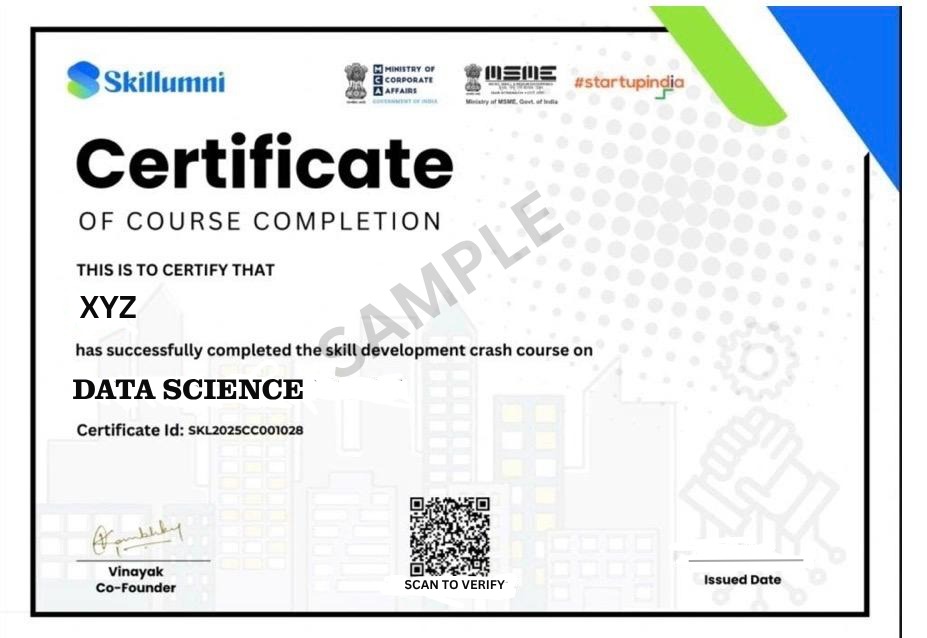
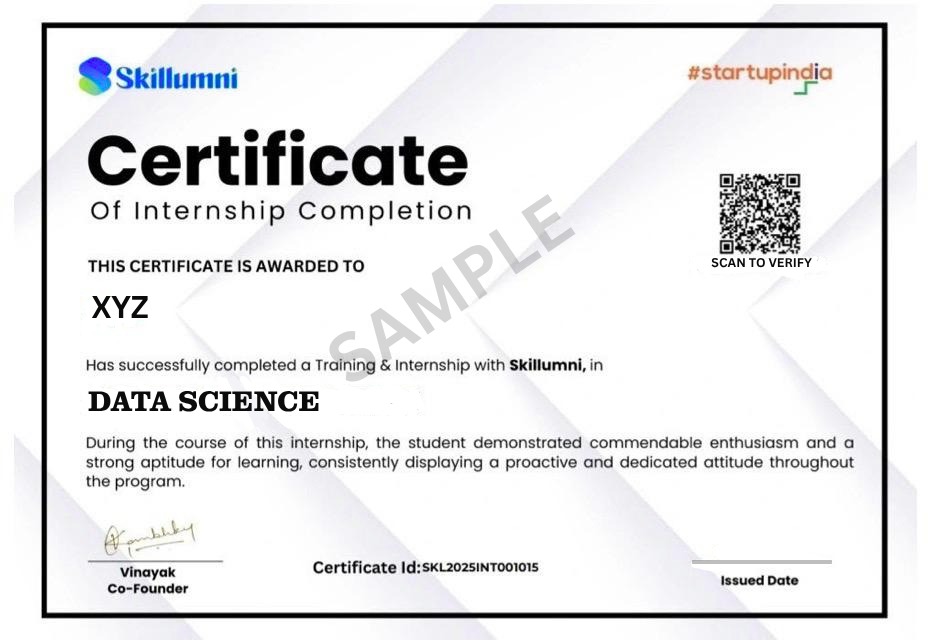
Your Dual Certificates
Two industry-recognized credentials awarded on successful completion
Why Choose This Course
Everything you need to go from curious learner to confident data scientist
Python Mastery
Complete Python programming, from fundamentals to advanced data science applications.
Data Visualization
Create stunning visual stories with Matplotlib, Seaborn, and Pandas plotting.
Machine Learning
Master supervised & unsupervised algorithms with Scikit-learn, end to end.
Deep Learning
Build neural networks with TensorFlow and PyTorch for real-world AI applications.
Hands-On Projects
Work on real analytics projects in big data, automation, and predictive modelling.
Career Ready
Build a portfolio, get placement support, and step confidently into a data scientist role.
Requirements
- No prior programming knowledge required — we start from scratch
- Basic mathematics understanding helps, but isn't mandatory
- A computer with a stable internet connection
- Curiosity and consistency to practice with real data
Material Includes
- 35+ hours of video lectures by MNC-certified trainers
- Lifetime LMS access — revisit anytime
- Section quizzes, assessments & assignments
- 10+ industry-based hands-on projects
- Course Completion Certificate
- Internship Experience Certificate
Simple, Transparent Pricing
Pick the learning style that suits you best — both include dual certification and placement support